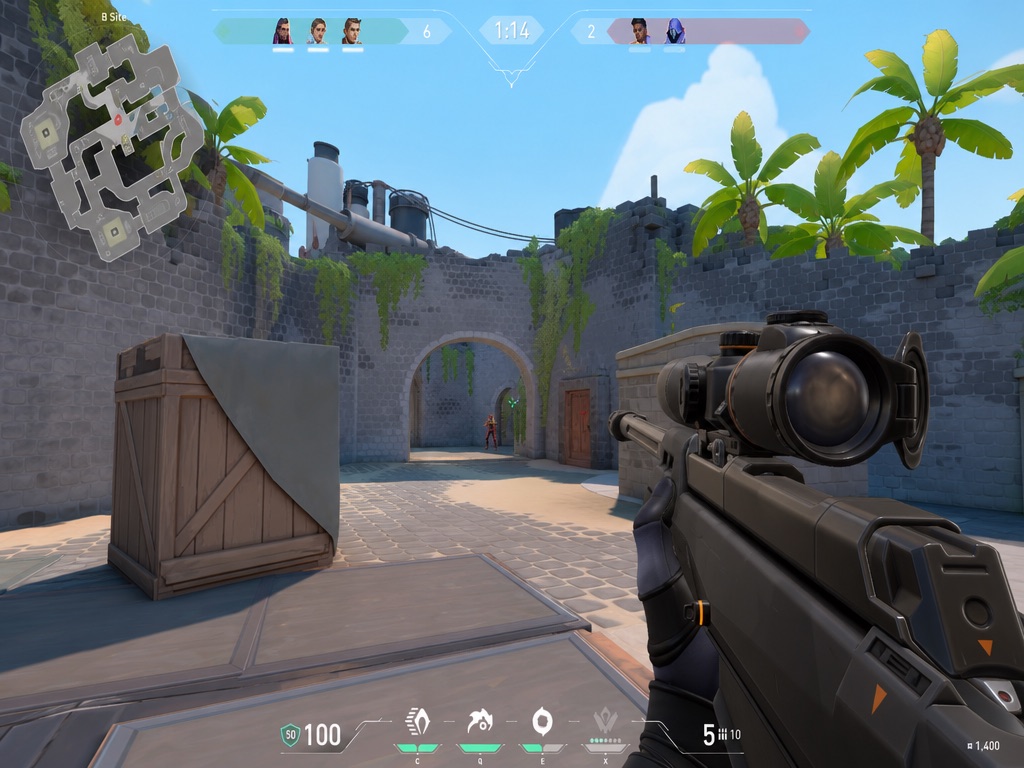
The best ranked crosshair is the one you can read without chasing it
Crosshair placement, movement, and timing matter more than a cosmetic preset. Your crosshair supports those skills by giving you a stable visual reference. If it disappears or covers the target, it creates extra work.
Use the rank groups below as starting directions. Keep any setup that remains visible and repeatable, even if it does not match the suggested style exactly.
Give a sensible baseline several sessions. Constantly changing shape, color, and gap makes it harder to build a familiar reference.
Rank-by-rank overview
| Rank | Primary need | Starting direction |
|---|---|---|
| Iron | Visibility and feedback | Bright color, medium lines, clear gap, optional firing error |
| Bronze | Stable center reference | Medium compact cross with outline |
| Silver | Cleaner target view | Slightly shorter lines, consistent gap |
| Gold | Balance clarity and obstruction | Compact cross, lighter outline |
| Platinum | Lower visual noise | Short lines or a small dot-cross hybrid |
| Diamond | Fast reacquisition | Compact high-contrast static cross |
| Ascendant | Role and weapon preference | Minimal cross tuned to personal sightline |
| Immortal | Consistency under pressure | Small static cross or precise dot |
| Radiant | Personal familiarity | Keep the proven profile; change only for a clear reason |
Iron to Gold: prioritize a visible, stable center
Newer players often lose the crosshair while tracking movement or reading utility. A bright green or cyan cross with medium-short lines and a small open center is a useful baseline. An outline can preserve visibility on mixed backgrounds.
Dynamic movement or firing error can help explain when the weapon is not accurate, but turn it off if the animation becomes the thing you watch.
Platinum to Ascendant: reduce visual noise carefully
As crosshair placement becomes more reliable, many players prefer shorter lines, a tighter gap, or a small dot-cross hybrid. The goal is not to make the crosshair as tiny as possible. It is to expose more of the target without losing the center during a fast correction.
Role matters more here. Entry-focused players may prefer a high-contrast cross that is easy to reacquire. Angle holders may prefer a calmer dot or minimal static cross.
Immortal and Radiant: familiarity beats novelty
At higher ranks, a crosshair is usually a deeply familiar reference. Small static profiles are common because they reduce obstruction, but copying a tiny pro-style dot is not helpful when it disappears for you. Keep the color and geometry that remain readable at your resolution and screen size.
How to know when to change
- Change color when the crosshair repeatedly blends into common scenes.
- Add a light outline when one color works but loses contrast in specific areas.
- Shorten lines when they cover head or body detail.
- Increase size only when you repeatedly lose the center during corrections.
- Avoid changing a setup simply because a different player uses another code.
Browse ranked recommendations on iPhone
Crosshair X Pro includes presets from Iron through Radiant, plus live preview and filters for tactical, minimal, role-based, and color-focused setups.
Find your ranked setup ↗